
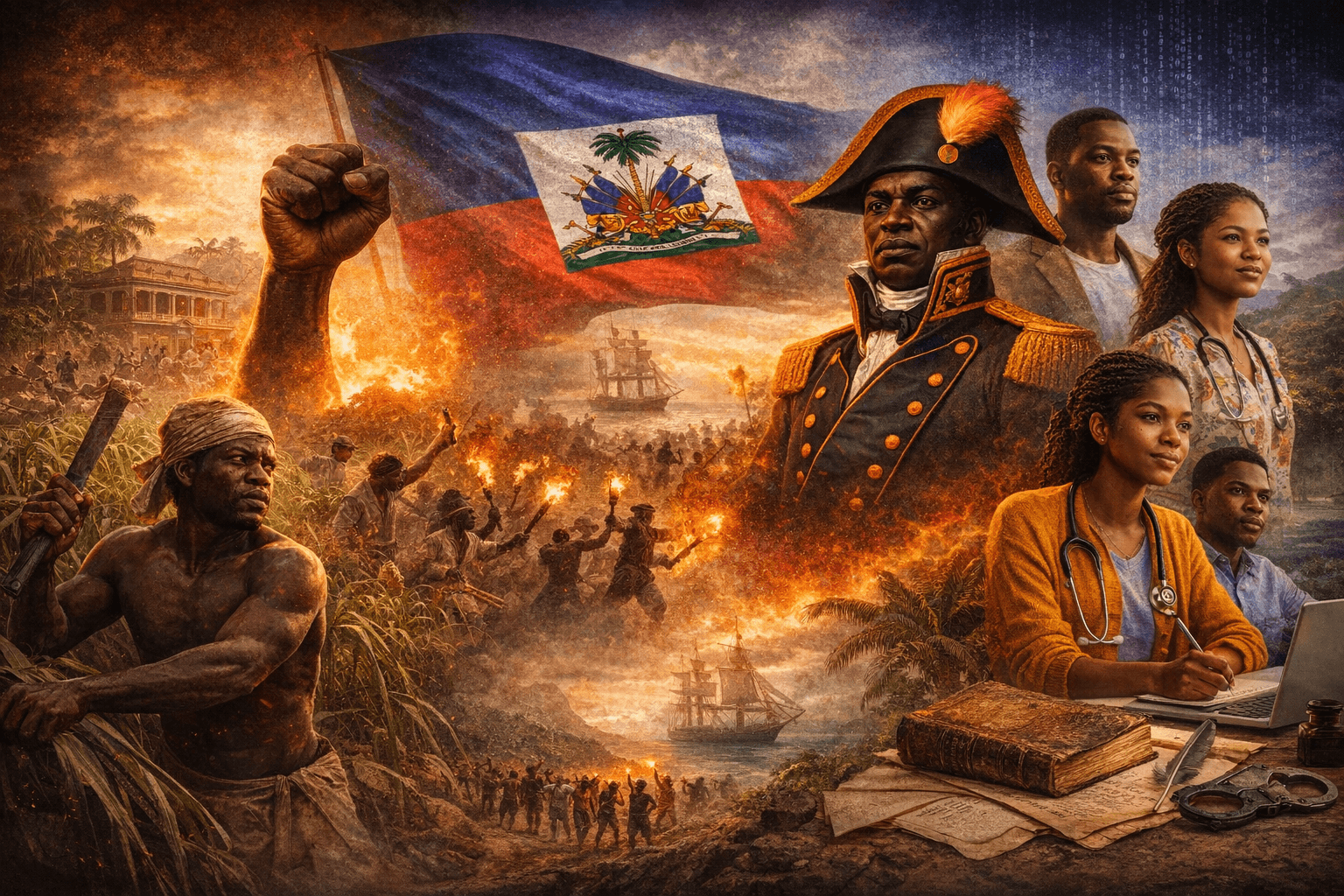
Every language tells a story. Few tell one as powerful, defiant, and deeply human as Haitian Creole: Kreyòl Ayisyen.
Born on the plantations of colonial Saint-Domingue. Forged in the only successful large-scale slave revolution in history. Suppressed for centuries by colonial-minded elites. Finally recognized as an official language in 1987.
Kreyòl Ayisyen is more than a means of communication. It is a monument to survival: the linguistic DNA of an entire nation and a global diaspora of millions.
Understanding this history matters for anyone who works with Haitian communities in healthcare, education, law, or government. It matters for anyone who believes language access is a fundamental human right.
Let's trace this remarkable journey from the 1600s to 2026.
The Crucible: How Haitian Creole Was Born (1600s–1700s)
A Colony Built on Brutality
The story of Haitian Creole begins with colonialism at its most brutal. In 1697, Spain ceded the western third of Hispaniola to France under the Treaty of Ryswick. The colony that emerged, Saint-Domingue, became the wealthiest in the Caribbean and arguably the most horrific.
By the 1780s, Saint-Domingue produced a staggering share of Europe's most prized commodities. According to BlackPast, the colony supplied roughly 40% of the sugar and 60% of the coffee consumed in France. Some historians, including Laurent Dubois in Avengers of the New World, extend these figures to the broader European market, though most reliable sources attribute them specifically to the French supply.
This wealth was extracted through enslaved labor on a massive scale. At its peak, the colony imported up to 40,000 enslaved people per year, according to the Trans-Atlantic Slave Trade Database. By the 1780s, the enslaved population numbered approximately 500,000, outnumbering the roughly 30,000–40,000 white colonists by more than twelve to one. An additional 30,000 free people of color (gens de couleur libres) occupied a precarious middle ground.
These enslaved people came from diverse regions of West and Central Africa: Senegambia, the Gold Coast, the Bight of Benin, the Kongo Kingdom, and beyond. They spoke dozens of distinct languages: Fon, Ewe, Wolof, Kikongo, Igbo, Mandinka, and many others. They had no shared tongue.
The Linguistic Necessity
This is the crucible in which Haitian Creole was forged.
Enslaved Africans needed to communicate with each other, with French overseers, and with free people of color. French was the language of power, but the enslaved population had limited and unequal access to it.
What emerged was not "broken French," as colonial prejudice would later claim. It was something far more remarkable: a new language.
Linguists classify Haitian Creole as a French-based creole language, meaning its vocabulary draws heavily from French. According to Ethnologue and other linguistic sources, roughly 80–90% of Haitian Creole's vocabulary has French origins.
But vocabulary is only one dimension of a language. The grammar, syntax, phonology, and deep structure of Kreyòl Ayisyen tell a different story, one profoundly shaped by West African languages, particularly those of the Niger-Congo family.
Not "Broken French" — A Language in Its Own Right
Several structural features distinguish Haitian Creole from French:
-
Tense-Mood-Aspect (TMA) markers replace French verb conjugations. Instead of conjugating verbs through dozens of forms, Haitian Creole uses preverbal particles: te (past), ap (progressive), pral (future). This system closely mirrors patterns found in West African languages like Fon and Ewe.
-
Definite articles follow the noun (postposed), not precede it. In French, you say la maison ("the house"). In Haitian Creole, you say kay la: the article comes after. This mirrors patterns in several West African languages.
-
Serial verb constructions, where multiple verbs are strung together without conjunctions, are common in Haitian Creole and rare in French, but widespread in Kwa and Bantu languages.
-
Nasal vowels and simplified consonant clusters reflect phonological processes influenced by African language substrates.
As linguist Michel DeGraff of MIT has argued extensively, creole languages like Kreyòl Ayisyen are full, complex, rule-governed languages. The persistent myth that they are "simplified" or "degraded" versions of European languages is a legacy of colonial ideology, not linguistic science.
Language of Revolution (1791–1804)
The Uprising That Changed the World
On the night of August 21–22, 1791, enslaved people in the northern plains of Saint-Domingue launched a coordinated uprising that became the Haitian Revolution, the most successful slave revolt in human history.
The Bois Caïman ceremony, traditionally dated to August 14, 1791, is widely regarded as the spiritual and political catalyst. According to oral tradition, the enslaved leader Boukman Dutty delivered a legendary prayer at this gathering, though historians continue to debate the exact details and language of the ceremony.
Over the next 13 years, the revolutionaries fought the armies of three colonial empires: France, Spain, and Britain, in a complex, shifting conflict. Britain withdrew its forces in 1798 after devastating losses from fierce resistance and yellow fever. Spain ceded its portion of the island. The final, decisive victory came against Napoleonic France on November 18, 1803, at the Battle of Vertières.
Kreyòl Ayisyen was the language of this revolution. Enslaved generals used it to coordinate military strategy across mountains and plantations. Freedom was imagined, planned, and won in Kreyòl.
French was the language of the colonizer. Kreyòl was the language of the people.
Independence and the Paradox of Language
On January 1, 1804, Jean-Jacques Dessalines declared the independence of Haiti: the first free Black republic in the world, the first independent nation in Latin America and the Caribbean, and only the second independent republic in the Western Hemisphere after the United States.
The very name "Haiti" was a reclamation, commonly traced to the indigenous Taíno word Ayiti, meaning "mountainous land" or "land of high mountains."
But here is the paradox that would haunt Haiti for two centuries: while Kreyòl Ayisyen was the language of the people, spoken by virtually the entire population, French became the language of the state.
The new Haitian elite, many of them mixed-race (mulâtre) and educated in French, adopted the colonial language for government, law, education, and prestige. This created a profound linguistic divide.
A small minority, widely estimated at 5–10% of the population, spoke French fluently and used it to access power and opportunity. The vast majority, 90–95% of Haitians, spoke only Kreyòl Ayisyen. They were effectively excluded from full participation in the institutions of their own nation.
Centuries of Suppression and Stigma (1804–1960s)
The "Language Question" in Haiti
For more than 150 years after independence, Haitian Creole was treated as a second-class language in its own country.
French was the sole language of instruction in schools, the sole language of the courts, and the sole language of official government business. Children who spoke Kreyòl in school were punished, sometimes physically, a practice documented by Haitian linguist Yves Dejean and other scholars of Haitian education policy.
This wasn't unique to Haiti. Across the post-colonial world, European languages were elevated while indigenous and creole languages were suppressed. But in Haiti, the dynamic was especially stark because Kreyòl Ayisyen was not a minority language: it was the language of the overwhelming majority.
The stigma ran deep. Speaking Kreyòl was associated with poverty, illiteracy, and rural life. Speaking French was associated with education and social mobility. Many Haitians internalized these hierarchies, creating what linguists call "diglossia," a situation where two languages coexist but occupy rigidly separate social domains.
Early Champions of Kreyòl
Despite the stigma, voices always advocated for Kreyòl Ayisyen.
In the 19th century, writers like Oswald Durand composed poetry in Kreyòl, most famously Choucoune (1883), a love poem later set to music by Michel Mauleart Monton around 1893. Decades later, that melody was adapted with different English lyrics into the internationally recognized song "Yellow Bird" in the late 1950s.
In the early 20th century, the American occupation of Haiti (1915–1934) paradoxically fueled a cultural nationalism that elevated Kreyòl. The indigénisme literary movement of the 1920s and 1930s, led by figures like Jean Price-Mars, author of Ainsi Parla l'Oncle (1928), called on Haitians to embrace their African heritage and Creole language rather than imitating French culture.
By the mid-20th century, Christian missionaries, particularly Protestant groups, began producing religious texts and literacy materials in Haitian Creole. They recognized that reaching the population required using the language the population actually spoke.
The Turning Point: Orthography and Official Recognition (1970s–1987)
Creating a Standard Writing System
One of the most significant milestones in the history of Haitian Creole was the development of a standardized orthography.
For centuries, Kreyòl was primarily an oral language. When written, various ad hoc spelling systems were used, including the McConnell-Laubach system developed in the 1940s and the Faublas-Pressoir orthography, often based on French conventions that were a poor fit for Kreyòl's sound system.
In 1979, the Institut Pédagogique National (IPN), with input from Haitian and international linguists including Yves Dejean, developed an official orthography for Haitian Creole. This phonemic system was designed so that each letter or letter combination corresponds to one sound, making it far more regular and learnable than French spelling.
The orthography was refined and officially adopted by the Haitian government in 1980 through the Bernard Reform, named after Education Minister Joseph C. Bernard.
This was a watershed moment. A standardized writing system meant Haitian Creole could appear in textbooks, newspapers, legal documents, and government communications. It transformed Kreyòl from a language that was "just spoken" into one that could be read, written, studied, and preserved.
The 1987 Constitution: A Historic Victory
The fall of the Duvalier dictatorship on February 7, 1986, opened the door to sweeping reforms. The 1987 Haitian Constitution, drafted in the hopeful aftermath of decades of authoritarian rule, contained a provision Kreyòl advocates had fought generations to achieve.
Article 5 of the constitution establishes that all Haitians are united by a common language, Creole, and that both Creole and French are the official languages of the Republic. (Note: The original text is in French; English translations may vary slightly across sources.)
For the first time in Haiti's history, Kreyòl Ayisyen was constitutionally recognized as an official language, equal in status to French. The constitution also mandated the use of Kreyòl in education and public administration.
This was more than symbolic. It acknowledged that a nation cannot be truly democratic if the majority of its citizens are excluded from civic life by language. It recognized that Kreyòl Ayisyen, born on plantations and spoken in revolution, was worthy of the highest institutional respect.
The Modern Era: Growth, Challenges, and the Digital Frontier (1987–2026)
A Language of Millions
Today, Haitian Creole is spoken by an estimated 9.6 to 12 million people worldwide, according to Ethnologue. The lower figure represents first-language speakers in Haiti; the higher estimate includes the global diaspora. In Haiti itself, virtually the entire population of approximately 11.7 million speaks Kreyòl as a first language.
But the language extends far beyond Haiti's borders. The Haitian diaspora has carried Kreyòl Ayisyen to cities across the globe:
-
United States: An estimated 1 million or more people of Haitian descent, including both Haitian-born immigrants and U.S.-born individuals of Haitian ancestry, are concentrated in South Florida (especially Miami's Little Haiti), New York City, and Boston. According to American Community Survey data, Haitian Creole is widely reported as the third most-spoken language in Florida after English and Spanish.
-
Canada: Significant communities thrive in Montreal and other Quebec cities, where Kreyòl exists alongside French and English.
-
France and its overseas territories: Haitian communities in Paris maintain connections to other French Creole-speaking populations in Guadeloupe, Martinique, and French Guiana.
-
Dominican Republic, The Bahamas, and across the Caribbean: Haitian migrant communities maintain Kreyòl as a living language.
Language Access: A Growing Priority
In the United States, growing recognition of language access as a civil right has created unprecedented demand for Haitian Creole translation and interpretation services.
Federal laws require organizations receiving federal funding to provide meaningful access to individuals with limited English proficiency (LEP). These include Title VI of the Civil Rights Act, the Affordable Care Act's Section 1557, and Executive Order 13166.
For hospitals in Miami, courts in Brooklyn, schools in Boston, and social service agencies across the country, providing services in Haitian Creole is not optional: it's a legal and ethical obligation.
Yet the supply of qualified Haitian Creole translators and interpreters has historically lagged behind demand. This gap is where technology and organizations like CreolePro play a critical role.
The Digital Revolution for Kreyòl
The 21st century has brought both challenges and extraordinary opportunities for Haitian Creole.
Globalization and the dominance of English and French in digital spaces threaten to marginalize smaller languages. But technology also offers powerful new tools for language preservation and access.
Several key developments stand out:
-
Haitian Creole in education: Efforts to expand Kreyòl-medium instruction in Haitian schools continue, though French still dominates higher education. The MIT-Haiti Initiative, led by Michel DeGraff, has demonstrated that teaching STEM subjects in Kreyòl dramatically improves student comprehension and engagement.
-
Growing digital presence: Haitian Creole content is expanding online, from social media to news outlets to educational platforms. Major technology companies have begun adding Haitian Creole to their translation tools, though quality remains inconsistent.
-
AI-powered translation: Advances in machine learning and natural language processing are making it possible to build high-quality translation tools designed specifically for Haitian Creole, tools that understand the language's unique grammar, idioms, and cultural context rather than treating it as a dialect of French.
Ongoing Challenges
Despite the progress, significant challenges remain:
-
Educational inequality: Many Haitian schools still lack adequate Kreyòl-language materials. The French-Kreyòl divide continues to reinforce social stratification.
-
Standardization debates: While the 1979–1980 orthography is widely accepted, debates continue about vocabulary development, technical terminology, and regional variation.
-
Persistent stigma: Internalized prejudice against Kreyòl persists in some segments of Haitian society and the diaspora. Some parents still prioritize French or English for their children at the expense of Kreyòl fluency.
-
Political instability: Haiti's ongoing political and humanitarian crises have disrupted educational institutions and language planning efforts.
Why This History Matters Today
Understanding the history of Haitian Creole isn't about the past alone: it's about the present and the future.
When a Haitian patient arrives at an emergency room in Miami and can't communicate their symptoms because no interpreter is available, that's a direct consequence of centuries of linguistic marginalization.
When a Haitian parent can't understand their child's school report because it's only available in English, that's a language access failure with real consequences.
When a legal proceeding moves forward without adequate Haitian Creole interpretation, justice itself is compromised.
Every time we invest in high-quality Haitian Creole translation, whether through professional human translators, AI-powered tools, or both, we push back against centuries of linguistic injustice. We affirm that Kreyòl Ayisyen is not a "lesser" language. It is a language with a rich history, a complex grammar, a vibrant literary tradition, and millions of speakers who deserve to be heard, understood, and served in their own tongue.
The Proverb That Says It All
There's a Haitian proverb that captures the spirit of Kreyòl Ayisyen's journey:
"Piti piti, zwazo fè nich li." — Little by little, the bird builds its nest.
From the plantations of Saint-Domingue to the constitution of a free republic. From oral tradition to standardized orthography. From stigmatized speech to a language powering AI translation platforms.
Little by little, Kreyòl Ayisyen has built its nest, and it's still building.
The next chapter is being written right now by linguists, technologists, educators, healthcare workers, legal professionals, and every member of the Haitian diaspora who speaks, writes, and preserves this extraordinary language.
References
-
BlackPast. "Saint-Domingue (1659–1804)." BlackPast.org.
-
Dubois, Laurent. Avengers of the New World: The Story of the Haitian Revolution. Harvard University Press, 2004.
-
Trans-Atlantic Slave Trade Database. slavevoyages.org.
-
Wikipedia. "Haitian Creole." Wikipedia.
-
National Museum of African American History and Culture. "The Haitian Revolution." Smithsonian.
-
Georgetown University Political Database of the Americas. "Haiti Constitution 1987."
-
Ethnologue. "Haitian Creole." SIL International.
-
DeGraff, Michel. MIT Linguistics Faculty Page. Massachusetts Institute of Technology.
-
MIT-Haiti Initiative. haiti.mit.edu. Massachusetts Institute of Technology.
-
U.S. Department of Justice. "Title VI of the Civil Rights Act."
-
U.S. Department of Justice. "Executive Order 13166."
-
U.S. Department of Health and Human Services. "Section 1557 of the Affordable Care Act."
-
U.S. Census Bureau. American Community Survey Data.
Ready to be part of that next chapter? Whether you need professional Haitian Creole translation for healthcare, legal, education, or business purposes, or you want to explore the language, CreolePro is here to help.
Try our AI-powered Haitian Creole translator at creolemt.com, or visit creolepro.com to learn more about our professional translation services.
Together, we can ensure the language born from resistance continues to thrive for generations to come.
Related services
Where this topic shows up in practice
If you are applying this topic to real documents, meetings, or client communication, these are the closest service paths.
Haitian Creole translation and interpretation
See the full range of document translation, live interpretation, and certified language support services.
View service pageLegal and immigration services
Explore USCIS-certified translations, court interpretation, and immigration-focused Haitian Creole support.
View service pageHealthcare language support
Review medical translation and interpretation options for clinics, hospitals, and patient communication.
View service page